Let’s Talk About What “Training” Actually Means
There is a shift underway in Australian cosmetic nursing, and it is one the entire industry needs to pay attention to.
According to industry estimates, the sector is now valued at over $4.1 billion and forecast to double by 2030, with more than five million procedures performed every year.¹ That growth tells a story of remarkable opportunity. But it also demands an honest answer to a question the industry cannot keep deferring:
Are cosmetic nurses and cosmetic doctors performing those procedures trained to the standard that patient safety and quality outcomes require?
The Australian Health and Regulation Agency (Ahpra) and the Therapeutic Goods Association (TGA) have been making their expectations clearer, and the message is clear. The future of cosmetic injectable practice requires rigorous, standardised training. The days of short courses and minimal oversight (especially practical) are numbered, and that will be a positive shift for the industry. For practitioners, for patients, and for the long-term credibility of an industry that has worked hard to earn its place in healthcare, robust education is not just a regulatory requirement. It is the foundation of patient safety.
To put this into perspective, the Therapeutic Goods Administration (TGA) received more than 1,800 adverse event reports related to cosmetic injectable products between 2016 and 2022, including vascular occlusion, infection, tissue necrosis, and vision loss. Under-reporting is widely acknowledged to be significant, meaning the true number is substantially higher.²
These conversations formed the focus of a recent APAN panel discussion, bringing together industry voices to explore one of the most important questions facing the sector.
The future of Australian Cosmetic Nurse Injectors: What the industry needs to do to provide compelling industry recommendations that will best support fair and uniform regulatory changes with AHPRA and the TGA.
This is a conversation we have been part of for more than a decade, and we are proud to have a seat at the table. And one of the voices we're most looking forward to hearing is Debbie Harris - Cosmetic Nurse, Trainer and Assessor with the Australasian Academy of Cosmetic Dermal Science (AACDS).
The Gap Between What Ahpra Expects and What’s Being Delivered
On 3 June 2025, Ahpra released updated guidelines strengthening safety and oversight within the non-surgical cosmetic sector, covering prescribing protocols, advertising practices, consent procedures, and, critically, education standards. The guidelines establish a clear minimum competency framework: anatomy and physiology, patient suitability assessment, theory on clinical management, psychological screening, assessing for body dysmorphic disorder, determining treatment suitability, supervised practical training, formal demonstration of competence, and complication management.
These are not administrative formalities. They reflect the genuine clinical complexity of injectable practice, a field where the consequences of inadequate training are presented by real patients. And yet the reality across the industry remains uneven. Not every provider meets these benchmarks. Not every course delivers genuine supervised hands-on time. Not every assessment reflects real-world clinical competency. The gap between what Ahpra now expects and what is currently being delivered is something the industry has to confront with honesty and urgency.
What Quality Education Actually Looks Like
Injecting is a clinical skill that takes time to develop. It cannot be compressed into a weekend, and a qualification that does not include genuine supervised practical experience and formal competency assessment does not prepare a nurse to practise safely. This is a position Australasian Academy of Cosmetic Dermal Science (AACDS) has held and championed since our founding, and one that the Ahpra guidelines now reflect clearly.
AACDS’s 52919WA Graduate Diploma of Cosmetic Nursing and Injectables runs over approximately 18 months. The first 12 months are dedicated to theory, covering skin science, pharmacology, patient suitability, ethics, and facial anatomy in depth. Students do not begin practical work until that foundation is firmly in place.
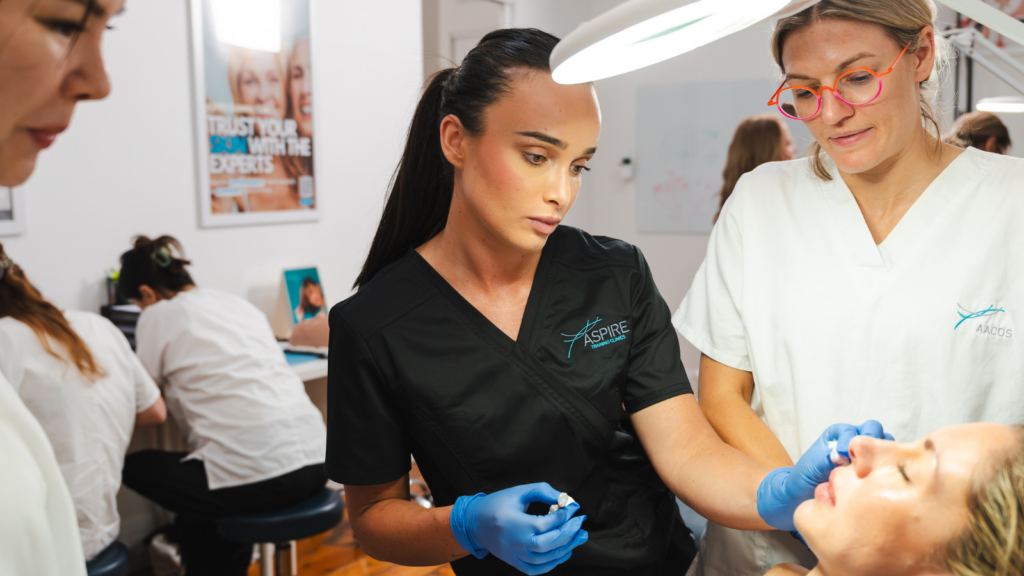
When they reach the clinical stage, they complete 13 days of intensive supervised training across both dermal therapy and injecting techniques, delivered inside the Aspire Training Clinics, fully operational clinical environments where students work under real conditions with real patients.
Every injecting practical session is supervised by both a doctor and a highly experienced registered nurse. Students demonstrate competency with genuine clinical oversight before they are deemed competent to practise independently. AACDS is Australia’s only accredited training provider in this space offering such a rigorous practical placement as well as in depth theory, and that accreditation represents a national standard.
Meet the Panellist: Debbie Harris
One of the voices joining this conversation is Debbie Harris, Cosmetic Nurse, Trainer and Assessor with AACDS. Debbie brings more than ten years of experience in the cosmetic and aesthetics industry to the panel, with a career that spans cosmetic injectables, clinical education, assessment, and practitioner mentoring.
As a practising cosmetic injector and educator, Debbie is passionate about the intersection of clinical excellence and quality training. Her work at AACDS focuses on supporting students and practitioners to develop safe, ethical, and evidence-based clinical skills, with a strong emphasis on building practitioner confidence and upholding industry best practice standards.
What the Panel Explored
The APAN conversation explored the governance, ethics, and professional development questions that matter most to the future of the sector.
The discussion explored what it means to establish a nurse-led Advisory and Governance Framework, what genuine Code of Ethics and Code of Practice compliance looks like when it is lived rather than simply stated, the role of independent industry-led standards to shape regulatory outcomes, and how practitioners can build a structured and sustainable approach to ongoing Professional Development.
This Is the Conversation You Can't Afford to Miss
Regulatory change is coming. The question is whether the industry helps define what fair and effective standards look like or simply has them imposed from outside. That requires contributing to the conversation with credibility and consistency, which is exactly what APAN facilitated through this industry panel discussion and what AACDS remained committed to as Australia’s leading accredited training provider in cosmetic nursing and cosmetic medicine.
Whether you are a registered nurse considering cosmetic training, a current practitioner navigating the regulatory landscape, a clinic owner or an industry stakeholder, this conversation is well worth your time.
Watch the full APAN panel discussion featuring AACDS Cosmetic Nurse, Trainer and Assessor Debbie Harris on APAN’s Solutions for Aesthetics YouTube channel.
This conversation around education and patient safety is too important to sit out.
References
- Australian Broadcasting Corporation. (2024, December 3). Botox and cosmetic injectable business is booming in Australia. ABC News. https://www.abc.net.au/news/2024-12-03/botox-and-cosmetic-injectables-business-is-booming-in-australia/10467140z
- Therapeutic Goods Administration. (2023), Adverse Event Management System (AEMS). Australian Government Department of Health and Aged Care. www.tga.gov.au.